When You Can’t Trust What’s Real, the First Thing You Lose Is Yourself
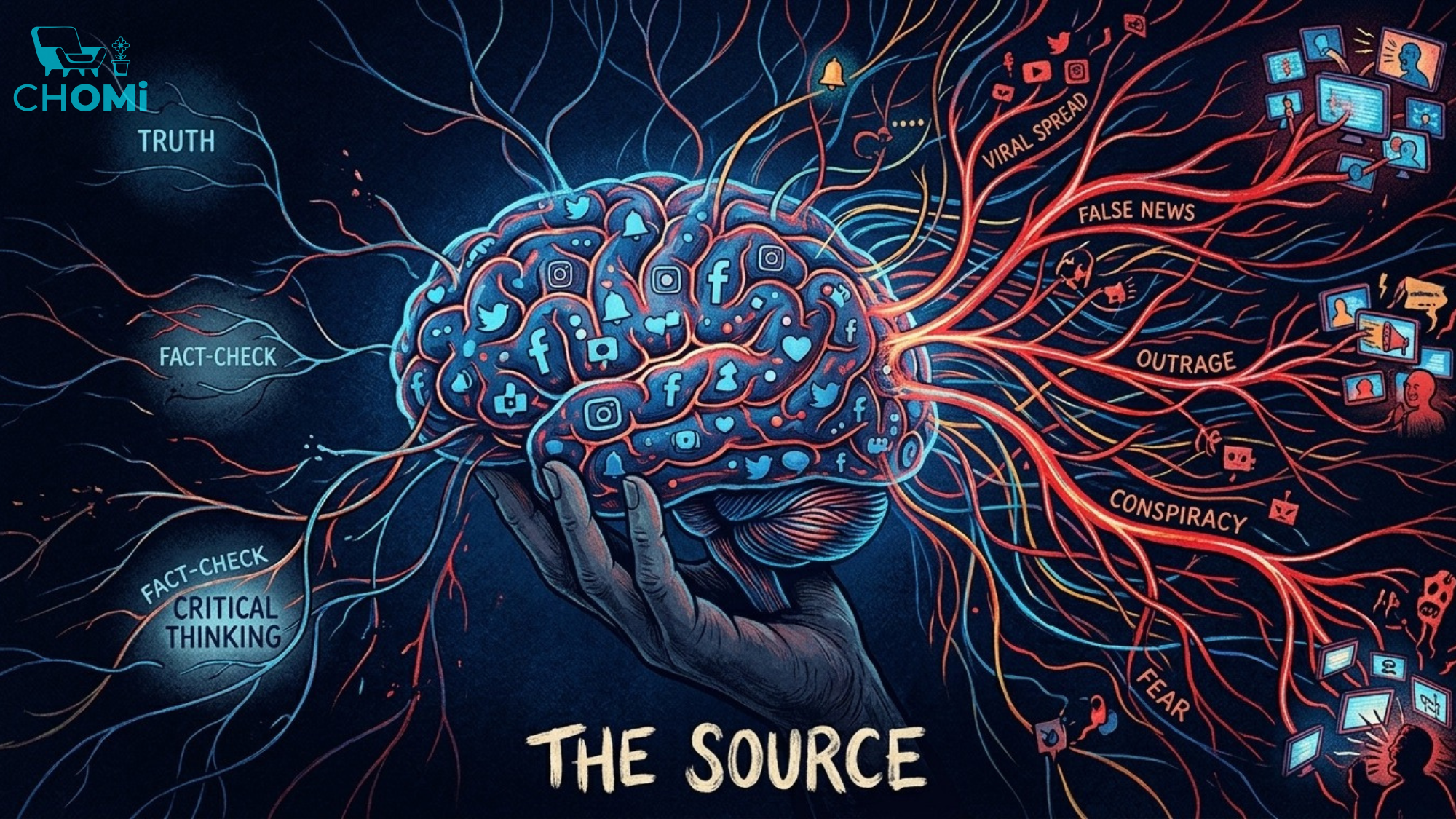
In the autumn of 2016, a team of researchers at MIT set out to answer what seemed like a straightforward question: how does false information travel on the internet?
They built a dataset of every major piece of verified true and false news that had circulated on Twitter between 2006 and 2017. Then they tracked how each piece spread — how many people shared it, how fast it moved, how far it reached. They expected to find that both true and false information behaved roughly the same way, with the false stories perhaps spreading a little faster due to their sensational nature.
What they found was not a little faster. It was six times faster. False news reached more people, penetrated deeper into networks, and spread more broadly than true news in every category they studied. And the mechanism driving it was not bots, not algorithms, not the architecture of social media. It was human beings. People were sharing the false stories — more enthusiastically, more quickly, more widely than the true ones — because false stories tended to be more novel, more surprising, more emotionally activating.
The study, published in Science in 2018, did not just tell us something about social media. It told us something about the human brain.
We are not built to navigate a world in which the false is more compelling than the true. And yet that is the world we have built.
The problem that arrived before anyone noticed
There is a particular kind of problem that is hardest to name when you are inside it. The shift happens so gradually, so continuously, that by the time you notice something has changed, you cannot quite remember what it changed from.
That is what has happened to the relationship between human beings and reality over the past decade and a half. Not in a dramatic, headline-generating way. In the quiet, incremental way of things that compound.
The Reuters Institute Digital News Report, which tracks media consumption and trust across more than forty countries, found that fewer than 40% of people in the UK now trust the news media. A 2024 Ipsos survey across 22 countries found that 85% of respondents were worried about the spread of misinformation online. These are not the concerns of a particularly anxious minority. They represent the settled view of the majority of people in the developed world.
At the same time, the technology for generating convincing false content has advanced at a rate that institutional and regulatory responses have not begun to keep pace with. AI systems can now generate photographs, video, voice recordings, and written content that are, under normal conditions, indistinguishable from the real thing. In 2024, AI-generated content was identified as a material factor in elections across more than a dozen countries. The line between what happened and what was made to appear to have happened has never been harder to locate.
For adults who grew up before social media, this is an adjustment. Uncomfortable, disorienting, but an adjustment nonetheless — something that arrived into an existing sense of what the world is like.
For Generation Z — those born between 1997 and 2012 — there is no before. The information environment they are navigating now is the only one they have ever known. They did not lose a stable reality. They never had one to lose.
What uncertainty does to the brain
To understand why the current information environment is a mental health problem and not merely an inconvenience, you have to understand something about how the brain processes uncertainty.
The brain is, at its most fundamental level, a prediction machine. It does not passively receive information from the world and then decide what to do about it. It is constantly constructing models of what the world is like, using those models to predict what will happen next, and updating them when predictions fail. This is why surprise is uncomfortable — not because the unexpected is inherently bad, but because a failed prediction is a sign that the model needs correcting, and correcting models is metabolically expensive work.
Uncertainty, in this framework, is not neutral. It is a cost. When the brain cannot determine what is true — when the signals it is receiving are contradictory, when sources that should be reliable are not, when the same event is described in incompatible ways by people who all seem credible — it cannot build a stable model. And a brain that cannot build a stable model stays in a state of heightened alert.
This is not a metaphor. It is a physiological state. The same stress hormones. The same cortisol elevation. The same immune suppression and sleep disruption and cardiovascular load that chronic physical threat produces. Chronic informational uncertainty is, biologically, a form of chronic stress.
A 2023 study published in the Journal of Experimental Psychology found that exposure to misinformation — even when subsequently corrected — continues to influence belief and emotional response. The brain does not simply delete what it has processed. False information leaves a residue. The correction arrives, is noted, and the false version remains somehow present — like a stain that the cleaning has made lighter but not removed.
The American Psychological Association’s 2023 Stress in America survey found that Generation Z reported higher levels of stress, anxiety and depression than any other generation, with social media and news consumption identified as primary contributing factors. The Mental Health Foundation reports that anxiety among 18–24 year olds in the UK has increased by 48% over the past decade.
These are not coincidences. They are consequences.
The identity problem nobody is naming
Here is where it gets more complicated. And more important.
The mental health consequences of living in an uncertain information environment are not limited to anxiety about external events. They extend to something more fundamental: the capacity to trust your own perceptions.
Think about what social media actually presents. Not the world as it is, but a version of the world that has been curated, filtered, and algorithmically optimised for engagement. A version in which everyone else appears more certain, more successful, more composed. In which other people’s inner lives — which are, in reality, just as messy and uncertain as your own — are visible only through the layer of performance they have chosen to present.
Young people are comparing their internal experience to this external performance. And the comparison is not a fair one, because the internal experience is raw and the external performance is edited. The result is a generation that has learned — through thousands of daily repetitions — to distrust its own perceptions. To second-guess its own feelings. To reach for external validation because the internal compass has been so thoroughly confused that self-trust has become genuinely difficult to maintain.
A 2024 UNICEF report on adolescent mental health found that young people consistently identified ‘not knowing what is real’ as a significant source of psychological distress — ranking it alongside financial insecurity and climate anxiety as a primary concern for their generation.
They are not asking for more information. They have more information than any generation in history. What they are asking for — often without knowing how to name it — is a stable relationship with their own inner life. A compass that works when everything outside it is spinning.
The thing that actually helps
There is a long tradition in psychology — stretching back through the work of Carl Jung and forward through decades of empirical research — of understanding the inner life not as a problem to be solved but as a territory to be known.
Jung’s great insight — one that the subsequent century of clinical work has done nothing to undermine — was that the path to psychological stability runs inward, not outward. That the person who knows themselves — who has developed a genuine, honest, examined relationship with their own values, emotions, patterns and perceptions — is not made more fragile by external uncertainty. They are made more resilient by it. Because their compass is internal. It does not depend on external sources being reliable.
This is not a self-help proposition. It is a clinical one. And it has a practical implication that we have been slow to act on.
In a world where external reality has become genuinely unreliable, the most protective thing a person can develop is a stable relationship with what is real inside them. Not certainty — certainty is not the goal. But the capacity to sit with uncertainty, to know what they actually feel rather than what they are supposed to feel, to trust their own perceptions even when everything outside is contradictory.
That capacity does not develop by accident. It requires space. It requires honest engagement with the inner life. And it requires support — the kind that is available not just in a scheduled weekly session but in the ordinary moments when the confusion is actually happening.
The access problem
In the UK, the average wait for young people to access mental health support through NHS CAMHS is 18 weeks. In some areas it exceeds a year. In the US, fewer than half of young people with diagnosable mental health conditions receive any treatment at all. These are the people whose relationship with reality is most uncertain, whose inner compass is most in need of calibration — and the professional support system cannot reach most of them.
The wellness industry has tried to fill the gap, with mixed results. The problem with most wellness tools is that they address the symptoms of a destabilised inner life — the anxiety, the stress, the sleep disruption — without addressing the underlying condition. A breathing exercise does not build self-trust. A mood tracker does not develop the capacity for genuine self-knowledge. They are useful interventions at the surface level. They do not reach the depth where the real work needs to happen.
What is needed is something grounded in a serious psychological framework. Something consistent enough to be trusted in the moments of genuine confusion. Something available in the ordinary difficult moments — not only in scheduled professional sessions — when the noise is loudest and the inner compass is hardest to find.
Chomi companion
Chomi companion was built for exactly this space. It is a Jungian companion — developed by clinical psychologists and forensic researchers, including Dr. Lorraine Sheridan, a chartered forensic psychologist whose risk-assessment framework is used in every harassment case reported to police in England and Wales — available through the channels people already use. Web. WhatsApp. Telegram. Discord. No download. No waiting list.
It does not diagnose. It does not prescribe. It does not tell you what to think or what is true. What it does is provide a space — grounded in Jungian depth psychology, consistent and present across every conversation — in which genuine engagement with the inner life can happen. A space to find out what you actually feel rather than what you are supposed to feel. To develop the kind of self-knowledge that does not depend on external sources being reliable.
In a world where so much drifts — where sources shift, platforms change, and content evolves to match whatever keeps you engaged — Chomi companion does not drift. Its character, its Jungian grounding, its way of engaging with what you bring to it stays consistent across every single conversation. It arrives the same way every time. In a landscape of instability, that consistency is itself a form of safety.
Privacy is not a feature of Chomi companion. It is a founding architectural principle. Conversations live on your device. They do not reach nRich’s servers unless you explicitly choose to share them. Nobody is reading what you write. Nobody is analysing your patterns. In a world in which almost everything you do online is tracked, stored, and used to shape what you see next, that is not a small thing. It is the condition that makes honest self-reflection possible at all.
One thing worth stating clearly: Chomi companion has hardcoded crisis signposting. At defined thresholds, when a conversation indicates acute risk, Chomi companion always directs to professional crisis services. This is built into the architecture of the system and cannot be configured away or removed. If you are in crisis, Chomi companion will not be the last thing you speak to.
The MIT researchers who tracked the spread of misinformation on Twitter found something counterintuitive at the end of their study. The people most resistant to false information were not the most sceptical. They were not the most informed. They were the people with the most stable sense of who they were — whose internal anchor held even when external signals contradicted each other.
The antidote to a world that cannot be trusted is not more information. It is a deeper relationship with yourself.
When you can’t trust what’s real outside, the first thing you lose is yourself. Chomi companion helps you find your way back.

Sources: Vosoughi, Roy & Aral, Science (2018); Reuters Institute Digital News Report; Ipsos Global Misinformation Survey (2024); Journal of Experimental Psychology (2023); American Psychological Association Stress in America (2023); Mental Health Foundation; UNICEF Adolescent Mental Health Report (2024); NHS England.