
Are Lonely People More Likely to Be Victims of Crime?
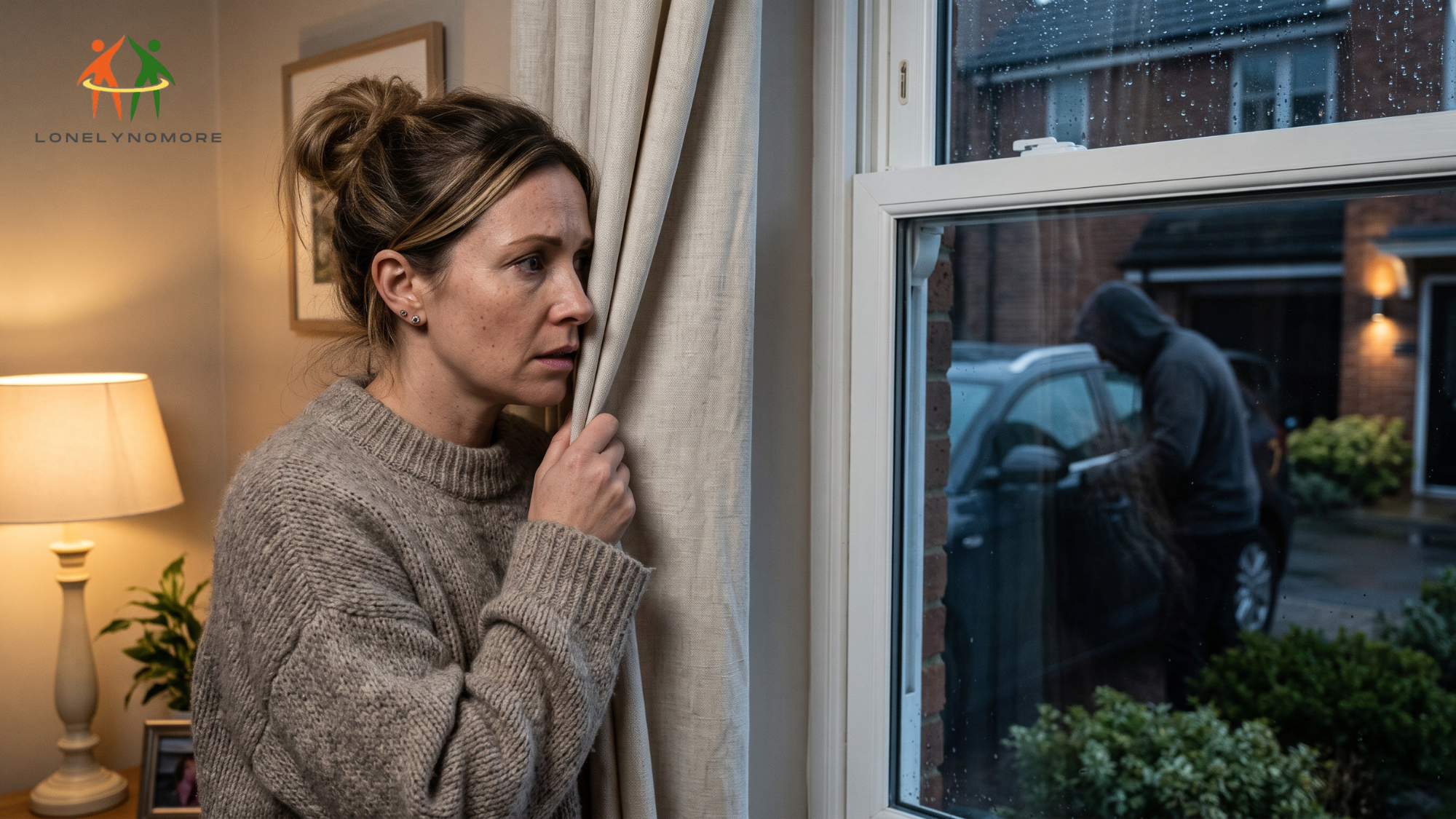
I went looking for a link between loneliness and crime. I found one, but not the one I expected.
In 1979, two sociologists, Lawrence Cohen and Marcus Felson, looked at the circumstances in which crimes happen, not at the people who commit them. Their idea was that illegal activities "feed upon the legal activities of everyday life." Most crimes, they said, need three things in the same place at the same time: a likely offender, a suitable target, and "the absence of capable guardians against crime."
The third is the one the authors suspected was neglected. A guardian doesn't have to be a police officer. They wrote that "guardianship by ordinary citizens of one another" may be "one of the most neglected elements in sociological research on crime."
That gave me a question. If ordinary people looking out for each other helps keep crime away, what happens to people who feel alone? I half expected the answer to be that lonely people are simply easier targets.
A Tempting Shortcut
In England and Wales, about one person in six aged 16 or over said they had experienced a crime in the year to March 2023. That covers things like theft, fraud and violence. Are they the same people who feel lonely? I started with age, and it looked like proof. The age group most likely to say they feel lonely often or always is 16 to 24: 9%, against 4% for people aged 65 to 74. That same age group is also the most likely to experience crime: 19.5%, against 16.1% for all adults. (Different surveys, so only a rough comparison.)
Case closed? Not quite. The Office for National Statistics says older people's lower risk may partly come down to time spent outside the home, including in pubs and bars. That explanation doesn't mention loneliness. Two things can move together for unrelated reasons. I needed studies that follow people, not age groups.
What Happens When You Follow People
Dutch researchers studied almost 20,000 adults from a register of twins and their families. Victims of crime were lonelier than non-victims, and the link was strongest for violent and sexual crime. Then came the detail that stopped me. Before the crime, victims of violent and sexual crime already scored higher on loneliness than a comparison group. The authors suggest that people with more loneliness and mental health problems are "at increased risk of becoming a victim."
A British study followed 2,232 children born in 1994 and 1995. Children who were lonely at 12 were more likely to be hurt by others in their teens, from bullying to crime. That held even after allowing for what had already happened to them. It ran the other way too: the more a young person had been through, the lonelier they were at 18.
The Twin Test
Then it got complicated. Both studies used twins, who share a family, and identical twins share all their genes. So the researchers could compare two twins where one had been a victim and the other hadn't. If harm made people lonelier, or loneliness made harm more likely, the victim twin should be the lonelier one.
In the Dutch study, there was no clear difference between them. In the British study, among identical twins, many of the links between being hurt and feeling lonely at 18 faded, though a few held. The Dutch authors say there is "no strong evidence" that the link is a simple case of cause and effect. Part of it may come from things that run in families, such as genes and upbringing.
None of this says crime doesn't hurt. It says the link between harm and loneliness is tangled, and I couldn't find a study that has fully untangled it.
The Missing Guardian
So I went back to that third ingredient. Maybe loneliness matters not because criminals can spot it, but because of who isn't there.
The clearest clues I found are about fraud. A survey of 1,408 people in the US and Canada looked at who loses money to scams. All had reported a scam to the Better Business Bureau. Those who lost money scored higher on a three-question loneliness scale (4.5 against 4.0, where scores run from 3 to 9). The report also found that people were "more likely to be victimized if they did not have anyone to discuss the offer with."
Scammers seem to know it. The report describes "scripts designed to negate intervention by third parties." They include telling people not to speak to anyone, and even coaching them on what to say to a bank teller.
It isn't only about fraud. A 1995 survey of 8,782 people in 343 Chicago neighbourhoods found less violence where neighbours trusted each other and were willing to step in. That held after allowing for differences between the people surveyed and for how violent the area had been before. It is about neighbourhoods, not individuals, but it points the same way.
What I Think
This part is my opinion, not a research finding.
I think we picture crime as two people: the one who does it and the one it happens to. We rarely ask who else was around, or who wasn't.
I think loneliness is partly a safety issue. Not because lonely people are careless or gullible. I found no evidence of that. Other people are how we check what is real. Picture two people who get the same odd message from a stranger. One shows it to a flatmate, who says "that doesn't sound right." The other has nobody to show, and is alone with the stranger's version of events.
I also suspect the link feeds itself. After being hurt, pulling away can feel safer, and that leaves fewer people looking out for you.
And I want to be plain about one thing. The blame belongs to the person who commits the crime. Whatever the research says about risk, it doesn't say a victim should have known better.
Back to Cohen and Felson. They said guardianship by ordinary people may be one of the most neglected parts of how we study crime. I think it is one of the most neglected parts of how we think about loneliness too.
What I Can't Say
I can't say that loneliness makes anyone a victim. The studies I found show links, not proof, and the twin studies suggest part of the link comes from things that run in families. The scam survey only included people who had reported a scam. In a US study of older adults already caught by mail scams, living with other people made no difference to how often they were scammed. So I'm wary of assuming that a full house means a guardian. I also haven't found a study that tests whether having someone to turn to prevents crime. The guardian idea is a theory with some support, not a proven fix.
If you have been a victim of crime, help is available. In England and Wales, Victim Support offers free, confidential help on 08 08 16 89 111, day or night. Being a victim is not a weakness, and neither is feeling alone.
A Different Starting Point
Full disclosure: I'm a co-founder of LonelyNoMore, and I want to be careful here. Nothing in this article shows that any product, including ours, can reduce crime or protect anyone from it, and I won't pretend it does.
What this research does reinforce, for me, is that feeling connected matters, and it seems reasonable to begin by understanding what you are missing. LonelyNoMore is a new community built to address loneliness. It is about friendship and feeling less alone, not romance. It starts with the music you already love, because the patterns in what you listen to quietly reflect deep psychological traits you may never have put into words. That is where the power of music and psychology come together. The approach draws on the OCEAN model, one of the most widely validated frameworks in personality science, and is developed in partnership with Professor Adrian North of Curtin University.
The first aim is simple: to help you understand yourself and feel less alone.
LonelyNoMore uses the power of music and psychology to help you understand yourself and feel less alone.
Start at https://lnm.world/
Sources
• Cohen and Felson (1979), American Sociological Review 44(4): 588-608: Social Change and Crime Rate Trends: A Routine Activity Approach.
• Office for National Statistics (6 March 2024): Crime in England and Wales: victim characteristics, year ending March 2023
• Department for Culture, Media and Sport: Community Life Survey 2024/25: loneliness and support networks
• Gonggrijp and colleagues (2023), Journal of Developmental and Life-Course Criminology 9: 455-482: Exploring the Relationships of Crime Victimization with Depression, Anxiety, and Loneliness in Twin Families
• Matthews and colleagues (2022), Development and Psychopathology 34(1): 367-377: A longitudinal twin study of victimization and loneliness from childhood to young adulthood
• BBB Institute for Marketplace Trust (2019): Exposed to Scams: What Separates Victims from Non-Victims?
• Sampson, Raudenbush and Earls (1997), Science 277(5328): 918-924: Neighborhoods and Violent Crime: A Multilevel Study of Collective Efficacy
• DeLiema and colleagues (2025), Innovation in Aging 9(2): igae111: The Effects of Risky Behaviors and Social Factors on the Frequency of Fraud Victimization Among Known Victims. Abstract only.