
The Strange Finding About Watching a Crisis on Screen
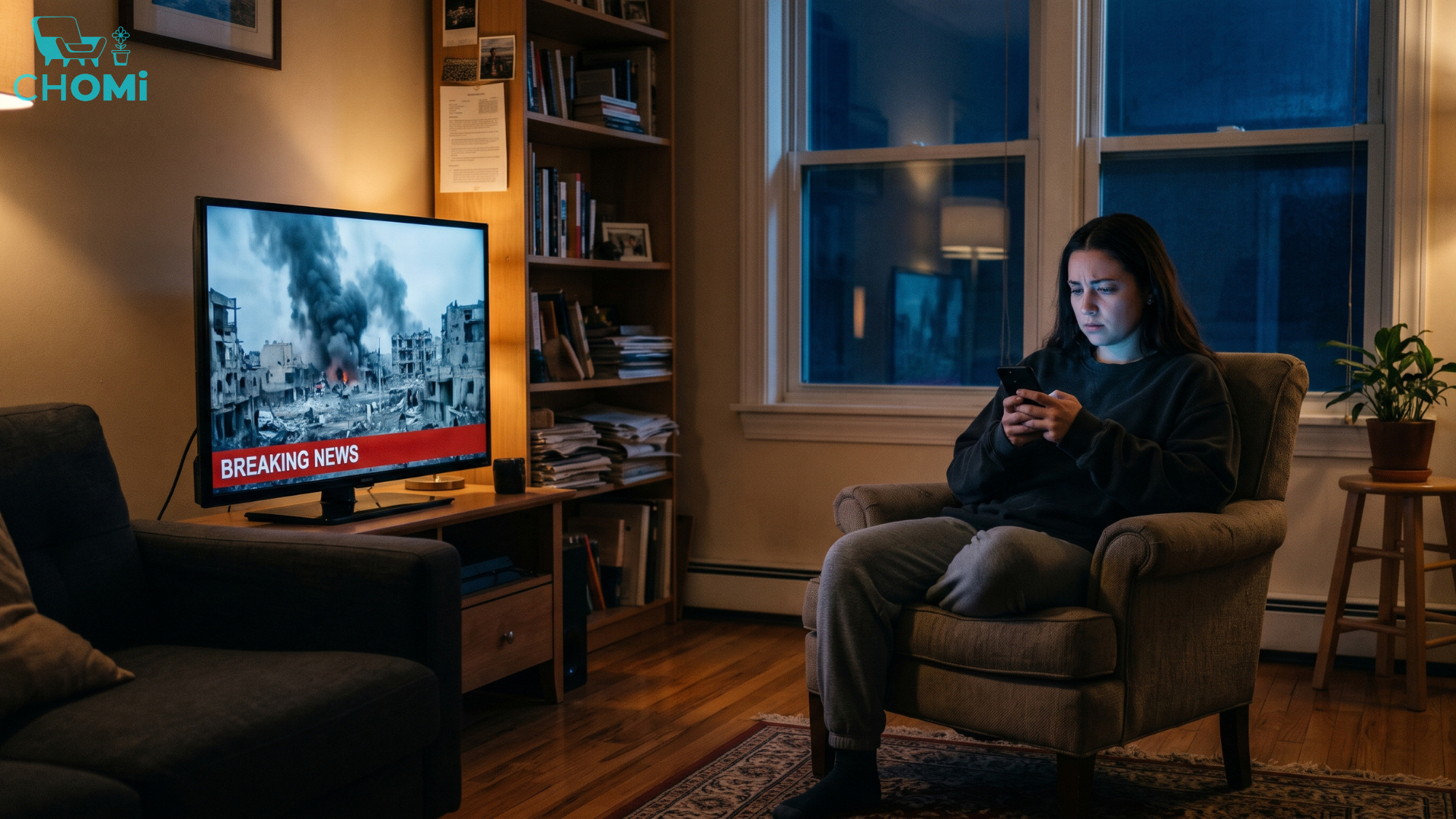
What the research says about living through a turbulent world, and what it can’t tell us about whether to have children in it.
In April 2013, two bombs exploded near the finish line of the Boston Marathon.
A few weeks later, psychologists at the University of California, Irvine surveyed 4,675 Americans. They asked who had been at or near the bombings. They asked how many hours a day people had spent following the coverage in the week afterwards. And they asked how many symptoms of acute stress people reported.
The finding was striking. People who spent six or more hours a day consuming bombing coverage reported more acute stress than people who had been at or near the bombings themselves. They were nine times more likely to report high acute stress than people who followed the story for less than an hour a day.
The data are correlational, and the study cannot prove that the coverage caused the stress. But it points to something worth saying plainly: you do not have to be anywhere near a crisis for it to reach you.
A world with more conflict than at any point in the records
That was one attack, in one city, over one week. Now consider what a phone delivers every day.
The Uppsala Conflict Data Program at Uppsala University, widely regarded as the leading source of data on organised violence, recorded 65 conflicts involving a state in 2025. That is the most since its records began in 1946. Conflicts directly between states quadrupled in two years, from two in 2023 to eight in 2025. Around 245,000 people were killed in conflict that year, according to its figures.
Those figures describe the world. This article is about the people reading about it.
What people are doing about it
The Reuters Institute’s Digital News Report 2026, based on more than 100,000 respondents in 48 markets, found trust in news at 37% globally, the lowest since the Institute began measuring in 2015. It also found that 42% of people say they sometimes or often avoid the news.
Why? In the 2025 edition, the most common reason given by people who avoid the news was its effect on their mood (39%), and 31% said they felt worn out by the sheer amount of it.
Surveys can’t tell us whether avoiding the news protects anyone. But the reason people give echoes what the Boston researchers were measuring: what it costs to keep watching.
One of the Boston study’s authors, Dana Garfin, has been careful to say she is not telling people to tune out. The key factor, she has said, is overexposure: returning again and again, for hours, to the same events.
Those who are living it
For people living through conflict directly, the picture is far starker. A 2019 analysis in The Lancet, led by Fiona Charlson with the World Health Organization, pooled 129 studies from 39 countries. It estimated that 22.1% of people in conflict-affected settings had depression, anxiety, post-traumatic stress disorder, bipolar disorder or schizophrenia at any point in time. That is about one in five.
Nothing in this article suggests that distress at a distance is the same as living through violence. People in that position need safety, practical help and professional and humanitarian support first.
The question people ask quietly
There is a question people ask at kitchen tables and rarely in print: is it fair to bring a child into this?
In 2021, a survey of 10,000 people aged 16 to 25 in ten countries, funded by the campaign group Avaaz and published in The Lancet Planetary Health, found that 59% were very or extremely worried about climate change. And 39% said they were hesitant to have children. That survey was about climate, not war.
A 2025 UNFPA and YouGov survey of about 14,000 adults in 14 countries asked more broadly. Around one in five said they would not be able to have the number of children they wanted. More than half said financial worries, such as housing costs, childcare and job insecurity, would likely lead them to have fewer. And around one in five said the state of the world, including wars, pandemics, politics and climate change, would likely lead them to have fewer children than they wanted.
Researchers studying Ukraine, where the fertility rate was already below 1.2 children per woman in 2021, concluded in a 2024 paper in the European Journal of Population that armed conflict creates its own forms of uncertainty, and that this interacts with economic pressures to dampen fertility.
Put together, the honest answer is more modest than the headlines. For most people, money seems to weigh more heavily than the state of the world. But for roughly one in five, the state of the world is part of the decision.
None of these studies can separate fear of the world from the cost of a nursery place, and surveys of what people expect are not records of what they do.
Somewhere to put it
One of the oldest findings in psychology points somewhere unexpected. In 1986, James Pennebaker and Sandra Beall reported that people who wrote privately about the most difficult experience of their lives made fewer visits to the health centre in the following months than people who wrote about neutral topics.
That study was about private writing, not the news. It does not show that putting a hard day into words protects anyone from a feed of bad headlines. What it suggests is narrower: that giving difficult material honest language can matter, and that many people have few places to do it.
Chomi companion
Chomi companion is not a news filter, a crisis service or a trauma tool. If you are living through violence or in acute distress, professional and humanitarian services come first. If you are in crisis, please contact emergency services or a crisis line: Samaritans on 116 123 in the UK, or 988 in the US.
For everyone else, it is a space to put into words what the world has stirred up: the headline that stayed with you, the conversation you couldn’t have at dinner, the question about the future you haven’t asked anyone. It is a Jungian companion, developed by clinical psychologists and forensic researchers including Dr. Lorraine Sheridan, a forensic psychologist whose risk-assessment form was, until recently, used in every harassment case reported to police in England and Wales. It does not diagnose, prescribe or make clinical claims.
It is available through web, WhatsApp, Telegram and Discord. No download. No waiting list.
Two things are worth stating plainly.
Chomi companion is designed not to drift. Its Jungian grounding, its character and the way it engages with what is brought to it are built to stay consistent across every conversation. In a world where so much shifts under your feet, a steady place to think is not a small thing.
And your conversations stay on your device. They do not reach nRich’s servers unless you explicitly choose to share them. Privacy here is a founding architectural principle, built into how the system works rather than promised in a policy. What you say about the world, and your fears for it, is nobody’s business but yours.
Chomi companion also has hardcoded crisis signposting. At defined thresholds, when a conversation indicates acute risk, it always directs to professional crisis services. This is built into the architecture and cannot be configured away.
In Boston, the people who spent the most hours watching reported more acute stress than the people who had been there.
Looking away is not the answer, and neither is watching everything. The world will keep reaching us. What matters is whether we have somewhere to put it down.
Chomi companion is built for exactly that.
chomi.world
Sources:
Holman, E. A., Garfin, D. R., & Silver, R. C. (2014). Media’s role in broadcasting acute stress following the Boston Marathon bombings. Proceedings of the National Academy of Sciences, 111(1), 93–98. doi:10.1073/pnas.1316265110.
Uppsala Conflict Data Program, Uppsala University, press release “UCDP: record number of conflicts between states” (9 June 2026); Peace Research Institute Oslo, Conflict Trends: A Global Overview, 1946–2025 (June 2026).
Reuters Institute for the Study of Journalism, University of Oxford, Digital News Report 2026 (published 16 June 2026) and Digital News Report 2025.
National Science Foundation, “Responding to terror (again): A study of the Boston Marathon bombing” (comments by Dana Rose Garfin).
Charlson, F., van Ommeren, M., Flaxman, A., Cornett, J., Whiteford, H., & Saxena, S. (2019). New WHO prevalence estimates of mental disorders in conflict settings: a systematic review and meta-analysis. The Lancet, 394(10194), 240–248. doi:10.1016/S0140-6736(19)30934-1.
Hickman, C., et al. (2021). Climate anxiety in children and young people and their beliefs about government responses to climate change: a global survey. The Lancet Planetary Health, 5(12), e863–e873.
UNFPA (2025). State of World Population 2025: The real fertility crisis (UNFPA/YouGov survey of about 14,000 adults in 14 countries).
Perelli-Harris, B., et al. (2024). Uncertainty and Fertility in Ukraine on the Eve of Russia’s Full-Scale Invasion: The Impact of Armed Conflict. European Journal of Population, 40, 28. doi:10.1007/s10680-024-09713-7.
Pennebaker, J. W., & Beall, S. K. (1986). Confronting a traumatic event: Toward an understanding of inhibition and disease. Journal of Abnormal Psychology, 95(3), 274–281.