Are People Lonelier Than Before? The Loneliest Person in Britain Is Probably Not Who You Think
The answer is yes. But the real surprise isn't how many people are lonely. It's who.
Ask almost anyone to picture the loneliest person in Britain, and they will describe the same person.
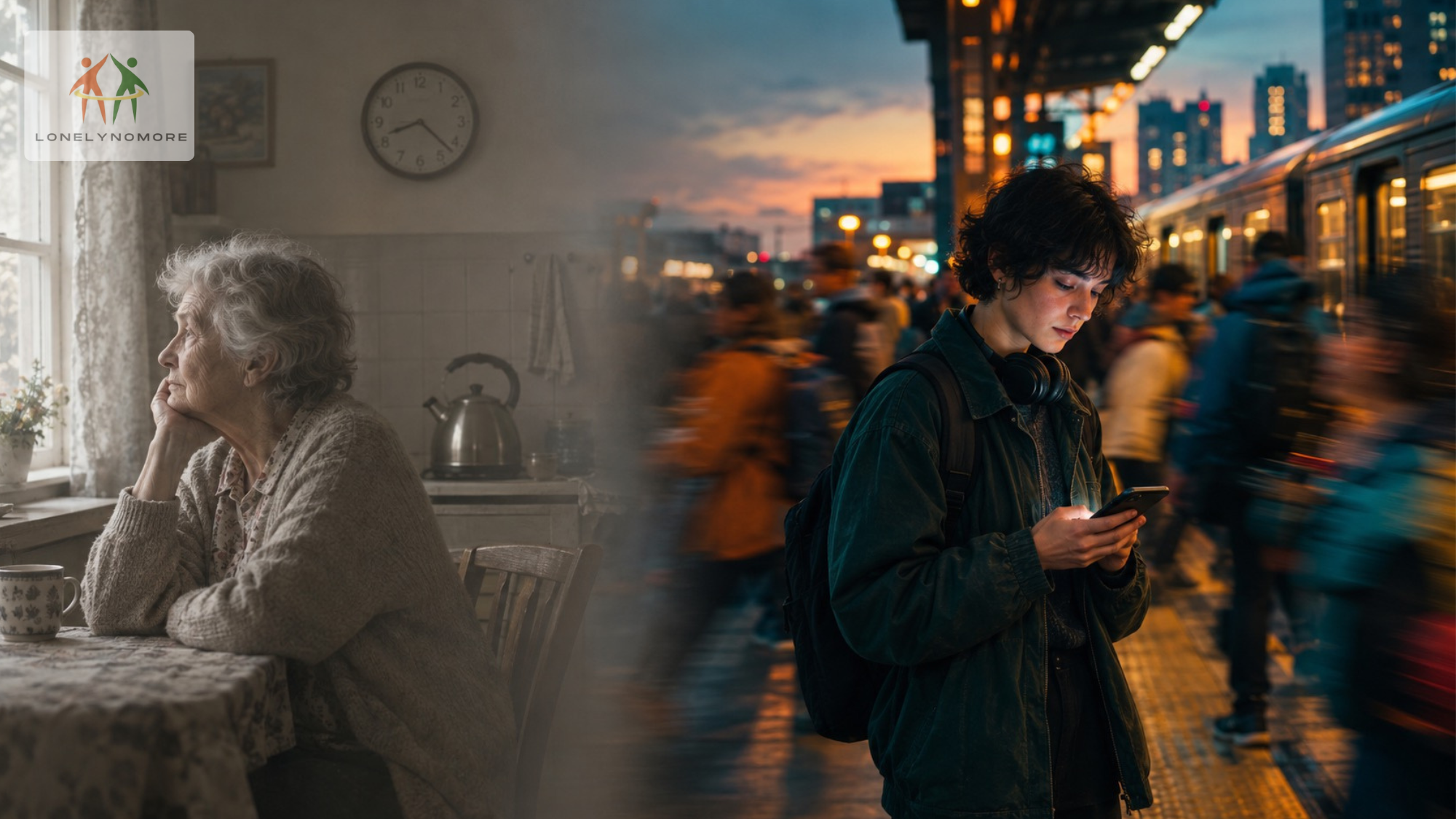
She is elderly. She is probably a widow. There is a kettle, a clock on the wall, and a telephone that doesn't ring. We have been imagining her for decades. Much of how we think about loneliness has been built around her. She is the face of the problem.
Now look at the data.
In ONS data analysed by the Campaign to End Loneliness, adults aged 16 to 29 were more than twice as likely as people over 70 to say they feel lonely often or always: 9.7% against 3.7%. Widen the question to loneliness at least some of the time, and a 2024 poll for the Centre for Social Justice found that 70% of 18 to 24-year-olds feel that way, compared with 32% of people over 75. So if you had to bet on the loneliest person in the country, you would not bet on a retirement flat. You would bet on someone in their early twenties, with a smartphone, a busy group chat, and more ways to reach other people than any generation in history.
That doesn't add up. And when something doesn't add up, it usually means we are asking the wrong question.
The Numbers, Briefly
In England, around 7% of adults say they feel lonely often or always, according to the government's Community Life Survey. Across Great Britain, ONS data from the winter of 2022 to 2023 put that group at an estimated 3.7 million people. Widen the question, and almost one in four adults (23%, ONS, early 2026) feel lonely often, always, or some of the time. One in four. That is the person next to you on the commute, your colleague on the video call, the person who looked perfectly fine at the gym this morning.
Are people lonelier than before? On the headline measure, yes. Chronic loneliness in England sat at around 5 to 6% for years before the pandemic, and has been around 7% since. That is a rise, not an explosion. The interesting part isn't the size of the number. It is who is feeling it, and what we find when we try to explain it.
Friday Night, Scrolling
Scroll through any social platform late on a Friday and you will find a certain kind of post. It doesn't go viral because it is funny or clever. It goes viral because it is painfully true.
"I haven't talked to anyone today."
"How do people live while being lonely?"
"I want to be lonely with someone."
Hundreds of people upvote these. They are not just venting. They are voting, with their thumbs, for someone to confirm that what they feel is real.
Here is the detail that matters. Many of these people are not isolated in the old sense. One writes: "I only have friends online but lately I also feel lonely with them. I have that feeling that I'm too different from them even though I like them." Another describes refreshing a comment feed all evening, waiting for a reply.
They have contact. What they don't have is the feeling of being known.
Researchers at Oregon State University found a similar pattern in 2025. They surveyed more than 1,500 American adults aged 30 to 70 and found that more social media use, whether measured in time spent or in how often people checked, was linked to greater loneliness. Frequent short checks were about as strongly associated with loneliness as a few long sessions. The study can't say which causes which, because lonely people may also reach for social media more. But whichever way the arrow points, more time on screens did not come with less loneliness.
We assume that more contact means less loneliness. The evidence suggests that contact and connection are two different things, and we have been getting very good at the first while quietly losing the second.
Nobody Decided This
No single event made us lonelier. If one had, we could point at it and fix it. What happened was three small shifts, each one reasonable on its own, and then a fourth that pushed it higher.
Work changed. For many people, the workplace was the main place they made friends. Shared lunches. Offhand conversations. The low-stakes social fabric of turning up somewhere together every day. Remote and hybrid work has made careers more convenient and relationships less so.
People move more. Young adults change cities and jobs more often than earlier generations did, and every move resets the clock. Friendship takes time, and the time keeps getting reset.
The third space faded. Pubs, clubs, community centres, religious institutions and local groups were the places where people used to bump into each other without needing a reason. Those places have steadily declined, and you cannot schedule a chance encounter.
Then COVID arrived. The pandemic did not create the loneliness crisis. It pushed up a problem that was already moving, and the numbers have not fully come back down. Many of us were already close to the edge.
What Eighty Years of Data Say About Being Known
In 1938, researchers at Harvard began following 268 sophomores, and they kept going. The study expanded to include the participants' children, and later hundreds of Boston residents from very different backgrounds. It became one of the longest studies of adult life ever run.
The question they were asking was simple: what keeps people healthy and happy as they age?
The answer was not wealth, fame, social class, IQ, or even genes. It was relationships. The study's director, Robert Waldinger, put it this way: "The people who were the most satisfied in their relationships at age 50 were the healthiest at age 80." Satisfaction with relationships at 50 predicted physical health at 80 better than cholesterol did.
Notice the word. Not numerous relationships. Satisfying ones. The good ones didn't have to be smooth. They had to be relationships where people felt they could count on each other when things got hard.
That is the other side of the paradox. If warm, reliable relationships protect health, then the absence of them is not a minor sadness. It is a risk.
This Is Not a Small Thing
We tend to talk about loneliness as if it were just a bit sad. It isn't.
The US Surgeon General's 2023 advisory found that lacking social connection can raise the risk of premature death as much as smoking up to 15 cigarettes a day. It reported that loneliness raises the risk of premature death by 26%, and social isolation by 29%. Poor social connection is also associated with a greater risk of cardiovascular disease, stroke, dementia, depression and anxiety.
The link with mental health runs both ways. In Great Britain, 55% of adults with moderate to severe depressive symptoms feel lonely often, always or some of the time, compared with 16% of those with no or mild symptoms. That is around three times the rate (ONS, April 2025).
The World Health Organization's Commission on Social Connection links loneliness to an estimated 100 deaths every hour, more than 871,000 a year worldwide. And a large 2024 study in Nature Human Behaviour found loneliness associated with 30 of the 56 diseases it examined. Genetic analysis suggested a likely causal role for six of them, including depression and sleep apnoea. For the others, loneliness may be better understood as a warning sign than a cause.
If any other preventable condition were doing this, we would call it a public health emergency. The world is only now beginning to.
The Thing No Statistic Can Capture
Statistics describe the scale. They don't describe what it feels like.
It feels like finishing a book you loved and having nobody to tell. It feels like cooking for one on a Sunday, with the faint sense that everyone else is somewhere you weren't invited. It feels like belonging to a group chat that is technically active while being somehow unreachable inside it.
The cruelest part is that modern loneliness often lives alongside a life that looks full. A good job. An active social media presence. And still, at 32, a post titled "lost and lonely" collecting 77 upvotes from strangers who recognise themselves in it.
It is a quiet epidemic. It doesn't announce itself. It slowly hollows out a life that looks fine from the outside until it stops making sense from the inside.
The Answer Was Never "More"
Here is what happens when people finally start being honest about this. They don't ask for more contacts. They don't want a bigger network or a better-curated feed. They want fewer people, but the right ones. They want the relief of being understood without having to perform a version of themselves first.
That is not a big ask. It is a very human one. And it points to a question most of the tools we use never ask: how do you find the right person if everything you've told the world about yourself is a performance?
A Different Question
Most platforms ask you to describe yourself. Pick some adjectives, write a bio, tick the boxes. In doing so you produce the version of yourself you want to project, which is not necessarily the one who turns up on a tired Tuesday.
LonelyNoMore starts from a different question. Instead of asking who you are, it listens to what you already love.
Music is one of the most honest human languages there is, and people rarely curate it for an audience. The patterns in what you listen to quietly reflect deep psychological traits you may never have put into words. That is where the power of music and psychology come together. LonelyNoMore draws on the OCEAN model, one of the most widely validated frameworks in personality science, which measures Openness, Conscientiousness, Extraversion, Agreeableness and Neuroticism. The approach is developed in partnership with Professor Adrian North of Curtin University, one of the world's leading researchers on the psychology of music. It reveals personality insight without questionnaires, and without asking you to perform.
The aim is to help you understand yourself, feel less alone, and be introduced to one person whose personality truly complements yours. Because the antidote to loneliness was never more people. It was always the right one.
LonelyNoMore uses the power of music and psychology to help you understand yourself and feel less alone, one real connection at a time.
Start at https://lnm.world/
Sources
• Campaign to End Loneliness, analysis of ONS Opinions and Lifestyle Survey data (April 2023): Younger Brits report higher levels of loneliness
• Centre for Social Justice (August 2024), poll by Whitestone Insight of 2,066 UK adults, 15 to 16 April 2024: Lonely Nation, Part 2: Ending loneliness among older people
• Department for Culture, Media and Sport: Community Life Survey 2024/25: loneliness and support networks
• Office for National Statistics (ONS): Public opinions and social trends, Great Britain: January 2026
• Office for National Statistics (ONS): Public opinions and social trends, Great Britain: April 2025
• Oregon State University (October 2025): Loneliness in U.S. adults linked with amount, frequency of social media use. Published in the International Journal of Environmental Research and Public Health, 2025, 22(10), 1510: doi.org/10.3390/ijerph22101510
• Harvard Gazette (April 2017): Over nearly 80 years, Harvard study has been showing how to live a healthy and happy life
• US Surgeon General (2023): Our Epidemic of Loneliness and Isolation, advisory on the healing effects of social connection and community
• World Health Organization (30 June 2025): Social connection linked to improved health and reduced risk of early death
• Nature Human Behaviour (2024): Observational and genetic evidence disagree on the association between loneliness and risk of multiple diseases